The Real Cost of Getting Epoxy Flooring Wrong (And How to Avoid It)
Surface Master Australia | | 9 min read
A cheap epoxy quote can cost 2-3x more in the long run. Here's every failure mode, what causes it, and how much remediation actually costs in Sydney.
 Illustrative image
The Hidden Cost of the Cheapest Quote
In Sydney's competitive epoxy flooring market, quotes for the same job can vary by 50 to 100%. When a homeowner in Penrith gets three quotes for a double garage — $1,800, $2,700, and $3,400 — it's tempting to think the cheapest gets the same outcome as the most expensive. In most cases, that is not true.
The lower-cost quote typically cuts costs in one or more critical areas: preparation time, product quality, coat count, or topcoat selection. The consequences of these shortcuts are predictable. They usually don't appear immediately — most failed floors last 6 to 18 months before obvious problems emerge. By then, the cheap contractor is long gone, and remediation falls to the homeowner.
After 15 years of installing and remedying epoxy floors across Sydney, here's what the common failure modes cost to fix.
Delamination: When Epoxy Lifts from the Concrete
 Illustrative image
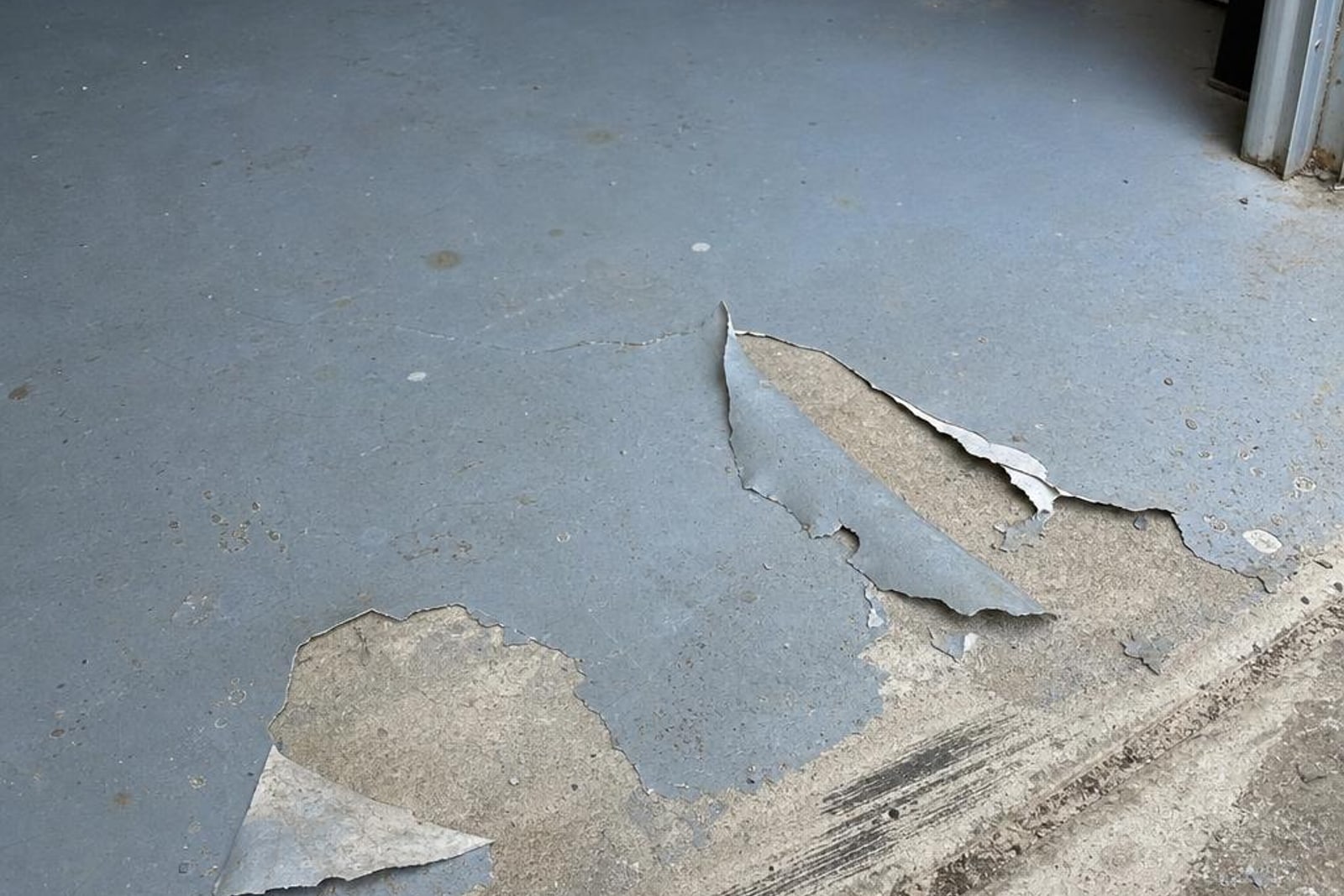
Delamination is the most common epoxy floor failure mode. It occurs when the bond between the epoxy system and the concrete surface breaks down. The floor develops bubbles, lifts in sheets, or peels from the surface entirely. In severe cases, large sections of the floor can be removed by hand.
Causes:
- Insufficient surface preparation — grinding profile too smooth for the coating system used
- Concrete surface contamination — oil, grease, or curing compounds not fully removed before coating
- Moisture vapour — elevated MVTR causing delamination from below
- Application in unsuitable conditions — low temperature, high humidity, or direct sunlight causing condensation on the surface
Remediation cost: Full removal of a delaminated epoxy floor requires grinding back to bare concrete — a process that, in a double garage, takes 4-8 hours with commercial equipment and costs $800–$1,500 in preparation alone, before any new coating is applied. Add full coating costs of $1,500–$2,500, and total remediation for a 40sqm garage runs $2,500–$4,000 — typically 1.5 to 2.5 times the original cheap installation cost.
Bubbling: Air and Moisture Trapped Beneath the Surface
Bubbling (also called outgassing or pinholes) appears as small to large bubbles in the epoxy surface, sometimes appearing within hours of application and sometimes developing over several weeks. Affected floors have a pitted, uneven appearance that collects dirt and is difficult to clean.
Causes:
- Applying epoxy to concrete in direct sunlight or high ambient temperature — as the concrete heats, air and moisture vapour expand and push through the wet epoxy before it cures
- Applying a thick coat over porous concrete without a penetrating primer — the primer seals the pores and prevents outgassing in the body coat
- Rushing the process — not allowing the primer to cure adequately before applying the body coat
Remediation cost: Minor bubbling may be addressed by sanding, spot-filling with thin epoxy, and recoating. Widespread bubbling typically requires full removal and reinstallation. Costs are similar to delamination remediation: $2,500–$4,000 for a standard garage.
Hot Tyre Pickup: Specific to Garage Floors
 Illustrative image
Hot tyre pickup is a failure mode specific to residential garage floors. It occurs when hot car tyres — particularly modern low-profile performance tyres that retain heat from extended highway driving — contact the epoxy surface and locally soften the coating. When the vehicle moves, the softened epoxy adheres to the tyre and pulls free from the floor. The result is tyre-shaped patches of bare concrete in the parking spots.
Cause: Use of standard epoxy topcoat rather than a heat-resistant polyaspartic or aliphatic polyurethane topcoat. Standard epoxy has a relatively low heat deflection temperature (50-60°C). Polyaspartic and aliphatic polyurethane topcoats have heat deflection temperatures of 90-120°C, effectively eliminating hot tyre pickup.
Prevention cost: Specifying a polyaspartic topcoat adds approximately $3-$8/sqm to the installation cost — around $150-$300 for a typical double garage.
Remediation cost: Repairing hot tyre pickup patches requires removal of damaged coating, spot grinding, and recoating — typically $500-$1,500 depending on the extent of damage. Preventing it costs a fraction of this.
The True Cost of Going Cheap: A Sydney Case Study
Consider a hypothetical (but entirely realistic) scenario:
- Homeowner accepts the cheapest quote of $1,800 for a 40sqm double garage epoxy floor
- Contractor uses acid etching instead of diamond grinding, single-coat body application, and standard epoxy topcoat
- Floor looks acceptable for 8 months, then delamination begins at the perimeter
- By 14 months, hot tyre pickup has created patches in both parking spots
- By 18 months, 60% of the floor has failed
- Professional remediation: $3,200 including full removal and quality reinstallation
- Total cost: $1,800 + $3,200 = $5,000 for what should have cost $2,700-$3,400 done correctly the first time
This scenario plays out regularly in Sydney garages. The 2-3x multiplier on failed floor remediation is consistent across our project history.
What to Check Before You Accept Any Epoxy Quote
Use this checklist before accepting any epoxy flooring quote in Sydney:
- Has the contractor done a site inspection and assessed the concrete?
- Is diamond grinding specified (not acid etching)?
- Are product names, coat count, and coat thickness specified?
- Is a polyaspartic or aliphatic polyurethane topcoat included for garage floors?
- Is a written warranty provided?
- Are they fully insured with current public liability cover?
- Do they have verifiable Google reviews from completed Sydney projects?
A yes to all seven is the baseline for a quality epoxy installation in Sydney.
FAQs
Why does epoxy flooring peel or delaminate?
Epoxy delamination almost always results from inadequate surface preparation. The three main causes are: (1) insufficient concrete grinding profile — smooth concrete doesn't provide enough mechanical key for epoxy adhesion; (2) surface contamination — oil, grease, or curing compounds not fully removed; (3) moisture vapour — elevated vapour transmission from below the slab breaking the epoxy bond from underneath.
Can you fix peeling epoxy flooring without replacing the whole floor?
In minor cases (small isolated areas), spot removal and recoating is possible. However, if delamination is widespread or if the cause (moisture, contamination, poor profile) was not addressed in the original installation, partial fixes will continue to fail. In most cases of widespread failure, full removal down to bare concrete and reinstallation is the only reliable solution.
Can you apply new epoxy over a failed or peeling floor?
No. Applying new epoxy over a failed floor will not resolve the underlying adhesion problems — the new coat will delaminate in the same way as the original. The failed coating must be completely removed by grinding, contamination addressed, moisture tested, and the surface brought to the correct profile before a new system is applied.
What causes epoxy flooring to bubble?
Bubbling (outgassing) in epoxy flooring is caused by: applying epoxy in direct sunlight or high temperatures (expanding air/moisture in concrete pushes through wet epoxy before it cures); applying body coats over porous concrete without a penetrating primer; or rushing the process and not allowing each coat to cure adequately before the next is applied.
How much does it cost to redo a failed epoxy floor in Sydney?
Remediation of a failed epoxy garage floor in Sydney typically costs $2,500–$4,500 for a standard double garage (40-50sqm), including full removal, surface preparation back to bare concrete, and quality reinstallation. This is typically 1.5 to 2.5 times the original cheap installation cost — making the initial saving entirely illusory.


